JetBrains Marketplace plugin

ServiceNow server-side development, inside JetBrains.

ServiceNow Dev Pro brings your instance into IntelliJ IDEA, WebStorm, and PhpStorm — pull, edit, and push Script Includes, Business Rules, Client Scripts, and UI Actions over ServiceNow's Table API, with a pre-push conflict guard and Update Set capture. Stay in the JetBrains IDE you already use instead of switching to VS Code for ServiceNow work.

ServiceNow Dev Pro tool window inside IntelliJ IDEA, listing Script Includes and Update Sets

ServiceNow Table API · IntelliJ IDEA, WebStorm, PhpStorm 2024.1+

ServiceNow Dev Pro

Browse and edit ServiceNow server scripts without leaving your JetBrains IDE. Open Script Includes, Business Rules, Client Scripts, and UI Actions as local JavaScript files with Glide type stubs, push changes back through a conflict guard that never overwrites silently, and capture your work in the current Update Set — all over ServiceNow's open Table API.

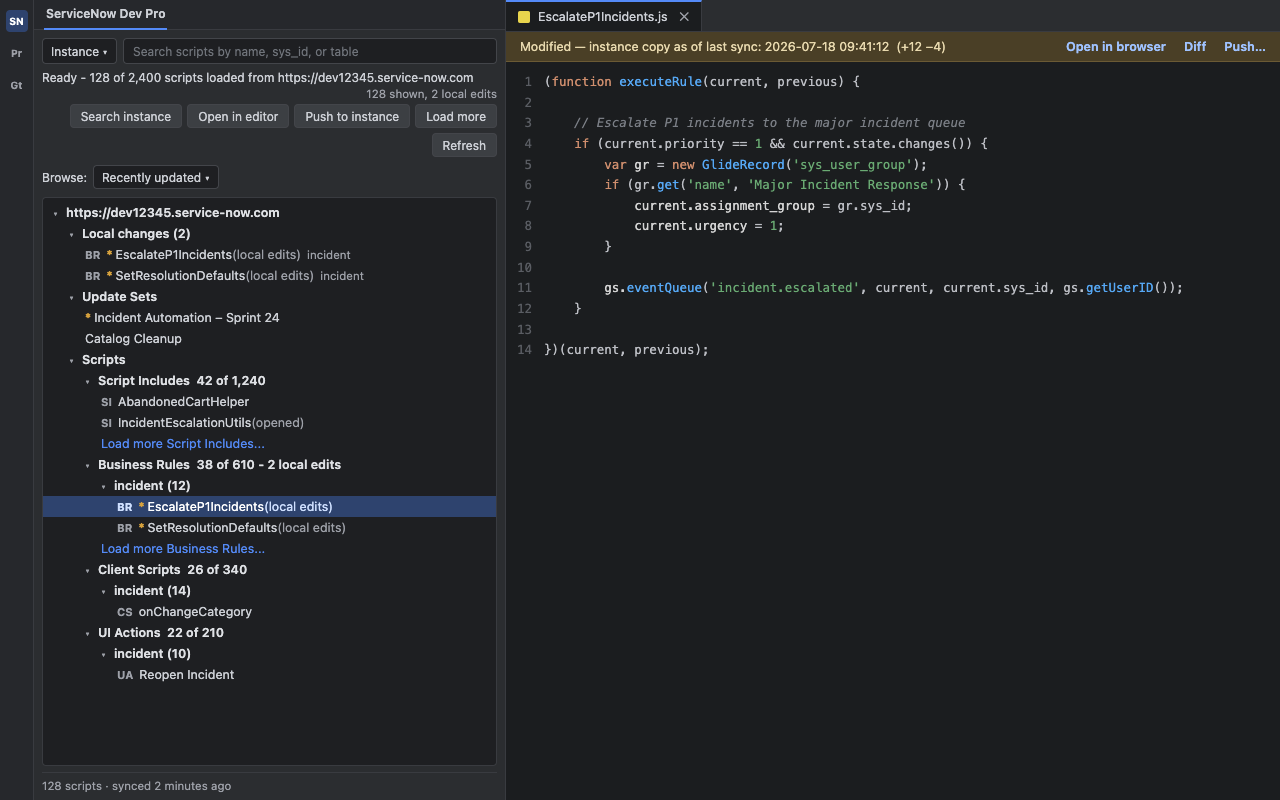
ServiceNow Dev Pro tool window listing the four script tables and Update Sets

One tool window, four script tables

Browse Script Includes, Business Rules, Client Scripts, and UI Actions from a single panel. Filter by name, sys_id, or table, see per-table counts, and page through large tables with Load more.

Edit in JetBrains, not a browser box

Open a record as a local JavaScript file and edit it with real IntelliJ tooling. Bundled Glide type stubs (GlideRecord, gs.*) give you syntax highlighting and basic completion instead of a cramped in-platform code field.

Push with a conflict guard

Before every push, the plugin re-checks the server copy. If the record changed on the instance since you opened it, a side-by-side dialog lets you overwrite or cancel — there is no silent overwrite and no lost work.

Update Set capture

See your in-progress Update Sets, set the current one from the tool window, and every push is captured in it — exactly like an edit made in the ServiceNow UI, ready to promote to test and production.

Credentials in PasswordSafe

Your API key — or, in OAuth mode, your client secret and refresh token — is stored in IntelliJ's PasswordSafe, backed by your operating system's keychain by default, never in project files, logs, or the plugin descriptor. The plugin never collects your ServiceNow account password at all.

Talks only to your instance

A bounded, HTTPS-only Table API client connects straight to the instance you configure. No Ngaio servers, no third-party analytics, no telemetry — your scripts never leave your machine except as calls to your own instance.

Guided from the first run

A built-in welcome screen and Getting Started guide walk you from connecting to your first round-trip, so the panel is never a blank wall of buttons.

01

Connect to your instance

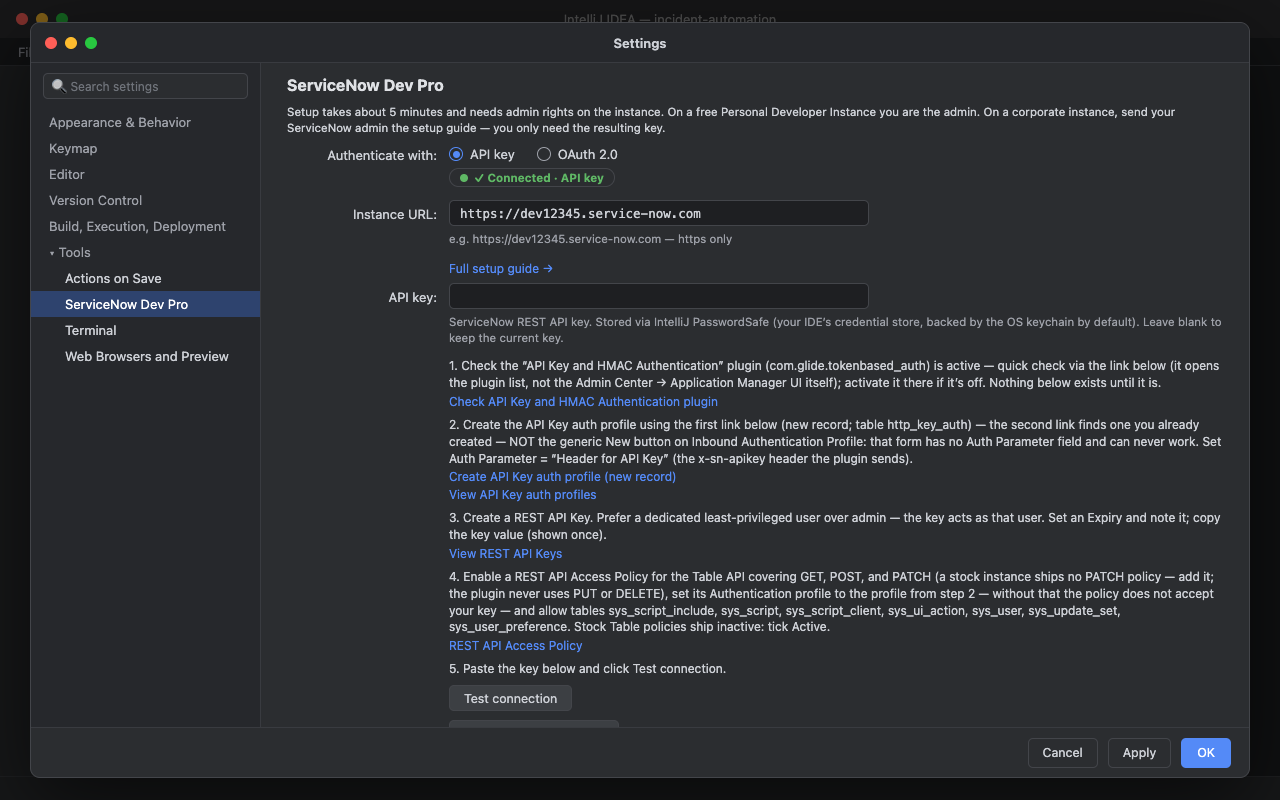
Open Settings -> Tools -> ServiceNow Dev Pro, enter your instance URL, and connect with an API key (simplest — ideal for Personal Developer Instances and developer instances) or OAuth 2.0 (Authorization Code with PKCE, one-click browser sign-in). The plugin never asks for your ServiceNow password. Click Test connection to confirm; your key/token is stored in IntelliJ's PasswordSafe through your OS keychain. Setup takes about 5 minutes and needs admin rights on the instance — see the full setup guide.

ServiceNow Dev Pro settings with instance URL and a successful connection
02

Browse your scripts

Click Refresh and the tool window loads Script Includes, Business Rules, Client Scripts, UI Actions, and your Update Sets. Filter by name, sys_id, or table, watch the per-table counts, and use Load more on tables with more than a hundred records.

ServiceNow Dev Pro tool window listing the four script tables and Update Sets
03

Open a script locally

Select a record and click Open in editor. The script downloads to a local JavaScript file with bundled Glide stubs, so you get highlighting and basic completion. Edit it like any other file — the tree marks it with local edits so you always know what differs from the instance.

04

Push back safely

Click Push to instance, or right-click in the editor and choose ServiceNow Dev Pro: Push Current Script. The plugin re-reads the server copy first; if it changed since you opened it, a side-by-side conflict dialog appears so you can overwrite or cancel. Nothing is ever silently overwritten.

05

Capture it in an Update Set

Pick an in-progress Update Set in the tree and set it current before you push. Your change is captured in that Update Set on the instance — visible in Customer Updates, exactly like an edit made in the ServiceNow UI — ready to move to test and production.

06

Verify on the instance

Scripts always run on ServiceNow, not in your IDE — this is an editor bridge, not a runner. Open the record in the ServiceNow web UI or run it from Scripts - Background to confirm your change is live. Your IDE stays the place you write; the instance stays the place code executes.


Free. ServiceNow Dev Pro 1.0.0 is free to install and use — no trial clock, no card, no license key. If a paid tier is introduced in a future version it will be announced here first and handled through JetBrains Marketplace.

Does it run or test my scripts in the IDE?

No, and that's by design. ServiceNow Dev Pro is an editor bridge: it pulls a script's text into your IDE, lets you edit it, and pushes it back over the Table API. Your scripts still run on your ServiceNow instance — a Business Rule fires on the server, a Client Script runs in the ServiceNow form. To execute one, open the record in ServiceNow or use Scripts - Background.

Which IDEs and versions are supported?

IntelliJ-platform IDEs on build 2024.1 or newer — IntelliJ IDEA (Community and Ultimate), WebStorm, PhpStorm, and other JetBrains IDEs built on the platform.

What authentication does it use?

Two passwordless modes — the plugin never collects, stores, or transmits your ServiceNow account password. An API key (simplest, recommended for PDIs and dev instances) sent under a dedicated header, or OAuth 2.0 as a public client (Authorization Code with PKCE, no client secret required) with one-click browser sign-in. Both need an admin to create a record on the instance first — an API Key auth profile and REST API key for the first, an Application Registry endpoint for the second — see the setup guide for exact steps.

Do I need a ServiceNow Store app or admin rights?

No ServiceNow Store app is involved — the plugin talks to the standard Table API. You do need a ServiceNow admin for initial setup: creating the API key auth profile and key (or, for OAuth, registering the Application Registry endpoint) are admin-only actions, though the resulting REST API Access Policy can then be scoped to a least-privileged user (governed by your instance's ACLs) rather than admin. On a free PDI you are the admin, so this is a one-time five-minute setup you do yourself; see the setup guide.

Which records can I edit?

Script Includes (sys_script_include), Business Rules (sys_script), Client Scripts (sys_script_client), and UI Actions (sys_ui_action). You browse, open, edit, and push these four server-script tables.

Where are my credentials stored?

In IntelliJ's PasswordSafe, which delegates to your operating system's secure credential store by default. Your API key and OAuth secrets are never written to project files, logs, or the plugin descriptor — and the plugin never asks for your ServiceNow account password in the first place.

What about my data and privacy?

The plugin connects only to the ServiceNow instance you configure. There are no Ngaio servers, no third-party analytics, and no telemetry. Read the Privacy Policy for the full Ngaio terms.

How is this different from the official VS Code extension?

It does the same core job — edit ServiceNow server scripts in a real editor — but natively in JetBrains. If you already live in IntelliJ IDEA, WebStorm, or PhpStorm for your other work, you stay there instead of switching to VS Code just for ServiceNow.

How much does it cost?

Nothing — version 1.0.0 is free to install and use, with no trial period and no license key. If a paid tier is introduced in a future version it will be announced on this page first and handled through JetBrains Marketplace.